Turbulence Generators and Compact Propagation Ranges
MZA manufactures mixed-air devices and deformable mirrors that generate optical aberrations to emulate extended path propgation effects in a laboratory environment.
ConvECT Mixed-Air Laboratory Turbulence Generator
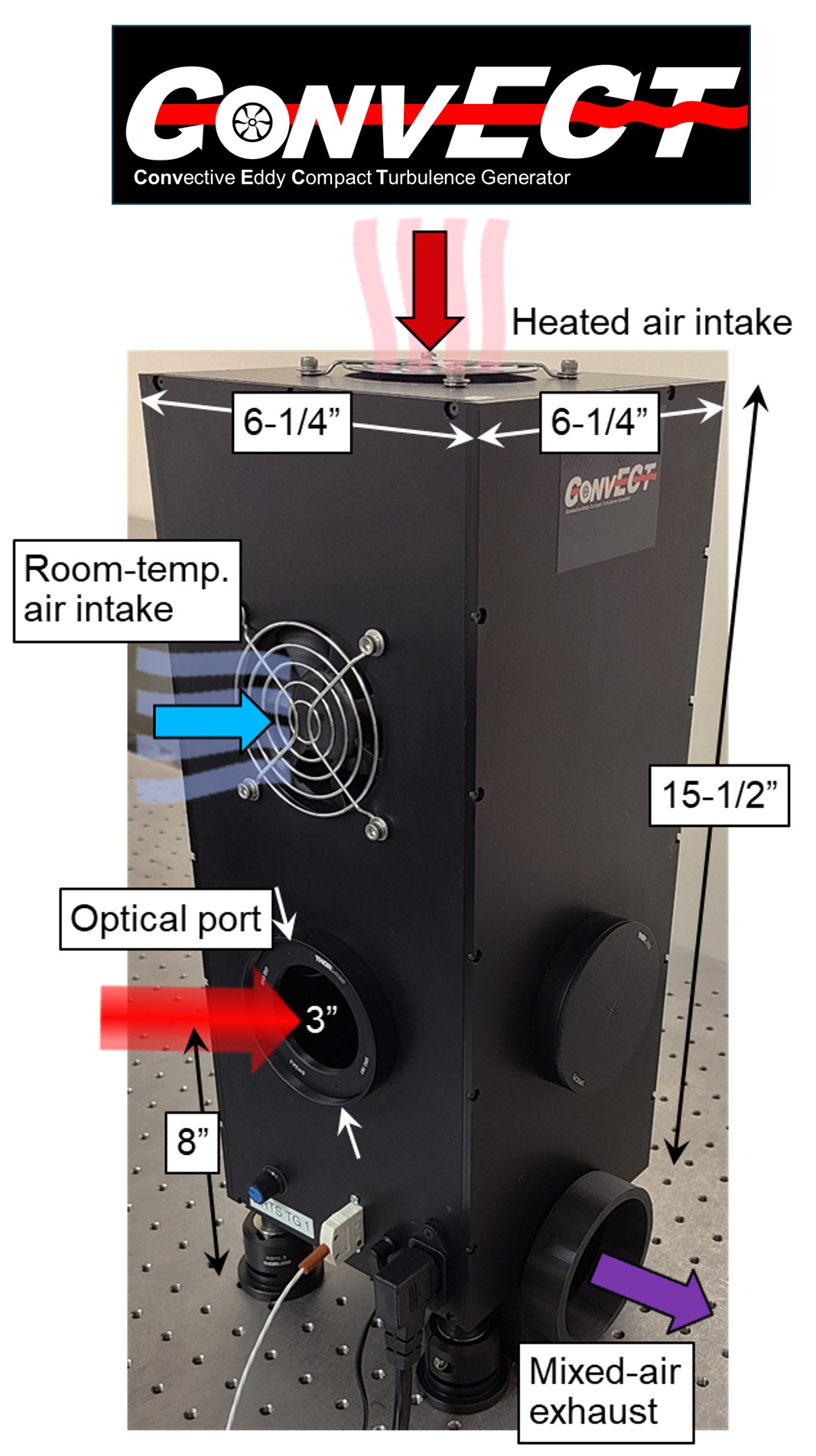
MZA’s Convective Eddy Compact Turbulence (ConvECT) generator units create real, dynamic turbulence for laboratory experiments. This allows researchers to test optical systems in a laboratory prior to use in outdoor, open-air experiments. The experimenter can adjust the turbulence setting to create known conditions for testing optical systems in parametric studies. This reduces technical risk and cost for outdoor optical experiments when distances at the test site are long enough that turbulence is a significant degrading factor. Optical turbulence degrades spatial coherence and imaging resolution. Accordingly, ConvECT units to add realism to laboratory measurements. MZA can provide other equipment like a wavefront sensor to observe the turbulence conditions during the test. MZA’s WavefrontTools and SlopeTools are ideal for analyzing data from such wavefront sensors. With this, the experimenter can correlate exact turbulence realizations with optical system performance. Heated air and room-temperature air are mixed inside the device to create convection and refractive-index fluctuations. The temperature difference controls the optical effect. The turbulence is blown downward into the beam path and then out the exhaust port.
Contact convect mza.com for more information.
Deformable Mirror Turbulence Generators
Deformable mirrors may also be used to generate specific wavefront patterns in an optical path. Applications include atmospheric turbulence and aero-optical disturbances. See MZA’s Beam Control technology.
Compact Propagation Ranges
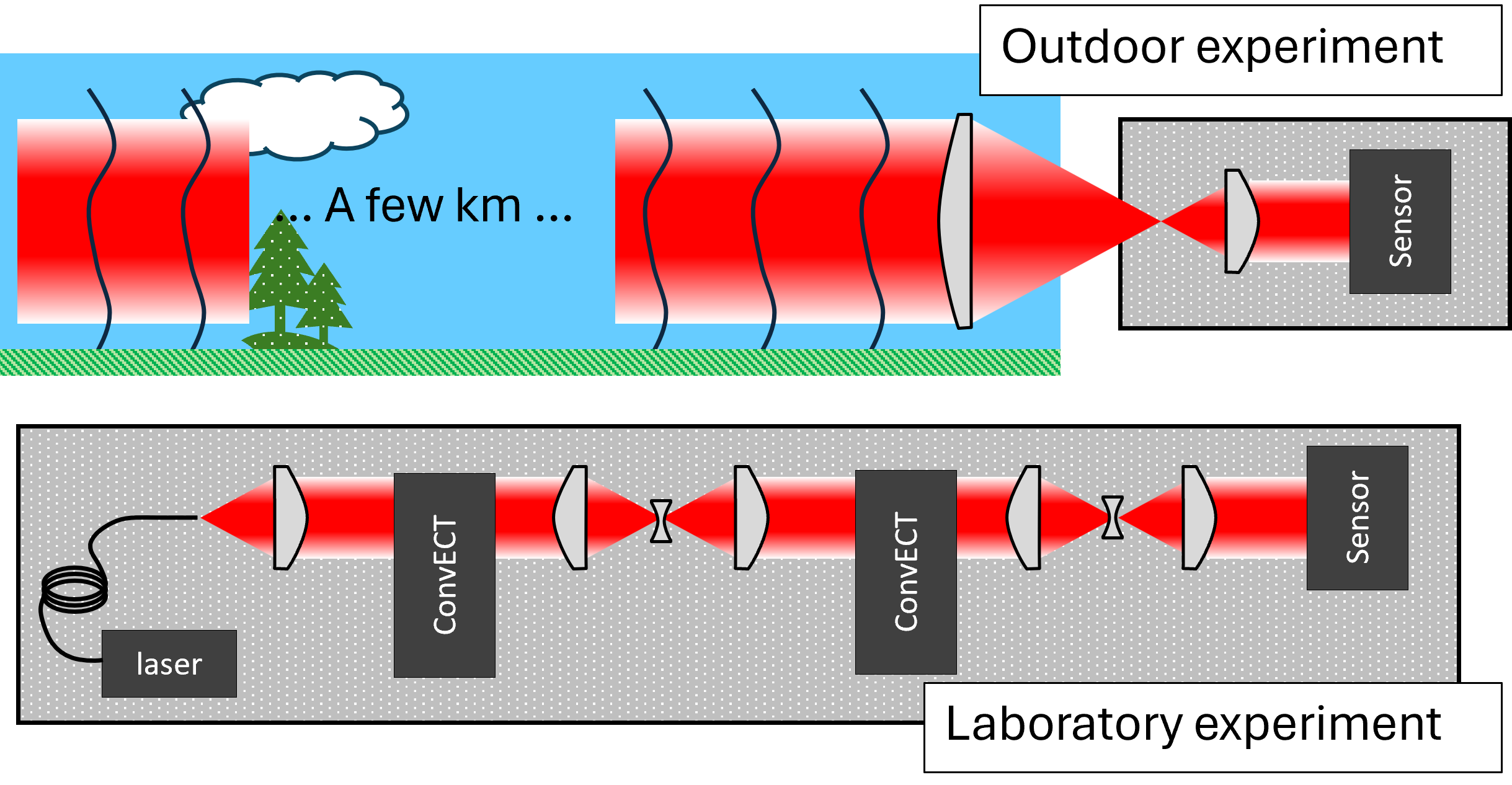
Thin phase screens can be used to emulate the effects of distributed volume turbulence in a laboratory. Fresnel scaling and appropriate relay optics can be used to scale multi-kilometer turbulence effects to fit onto a standard optical table. Diffraction effects for two beams are equivalent if they have the same Fresnel number. This way, the propagation distance scales with the square of the beam diameter. When a 30 cm beam outdoors is shrunken to 3 cm indoors, the propagation distance shortens by a factor of 1/100. 10 km outdoors becomes only 100 m indoors. Additionally, a three-lens system can achieve the effect of a much longer propagation distance in a compact space. We could use two ConvECT generators with 50 m of propagation each, which only takes a few meters of table space. To match the turbulence effect between long propagation outdoors and compact propagation in the laboratory, we adjust the settings on ConvECT so that D/r0 and the Rytov number in the laboratory to match the outdoor path. While outdoor turbulence varies throughout the day, the laboratory setup matches one condition at a time, which works for parametric studies.
Laboratory Validations for Simulations
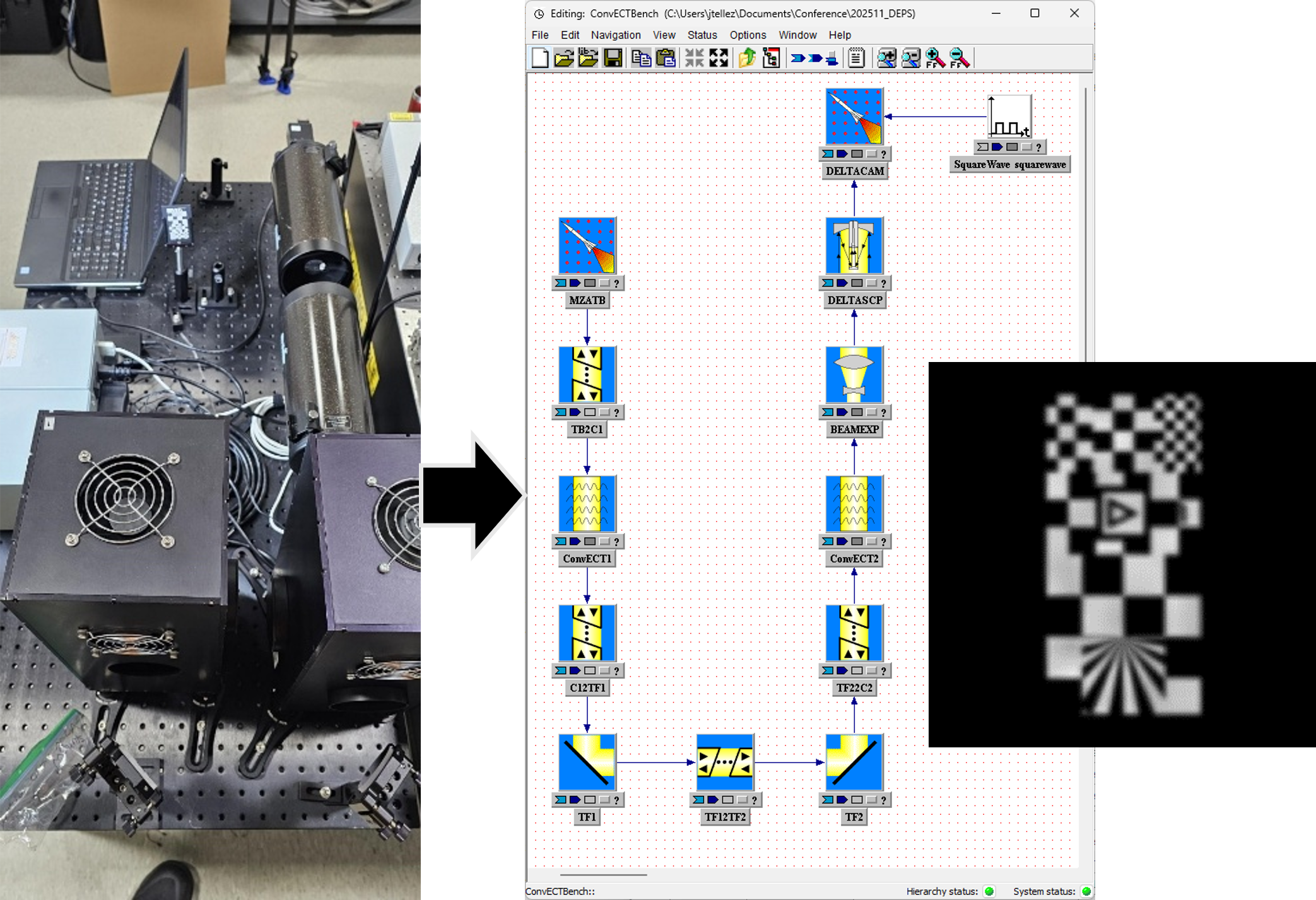
WaveTrain components can be grouped together creating a system of systems with functionality representing your real-world hardware. This creates a near one-to-one mapping of components from the system design to WaveTrain simulation to hardware. Custom, third party software can be easily integrated into a WaveTrain component enhancing the effectiveness of the simulation. The example here is a bench layout of a DELTA sensor imaging through two ConvECT turbulence generators.