Library & Archives

Publications & Research

Access MZA’s latest books, reference resources, external press coverage, and technical publications in high-energy laser systems and wave-optics modeling.

Books

Aero-Optical Effects: Physics, Analysis and Mitigation

Aero-Optical Effects: Physics, Analysis and Mitigation

Co-authored by MZA's Dr. Matthew Whiteley, this book provides a comprehensive analysis of aero-optical turbulence, air-buffeting jitter, and measurement techniques, while detailing flow control and adaptive optics strategies to mitigate beam degradation on airborne laser platforms.

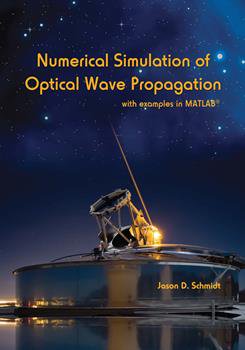
Numerical Simulation of Optical Wave Propagation with Examples in MATLAB

Numerical Simulation of Optical Wave Propagation with Examples in MATLAB

Authored by MZA's Dr. Jason Schmidt, this book is a practical guide to FT-based analysis, imaging systems, and wave-optics simulations. Features chapter problem sets and downloadable MATLAB® code examples.

Resources & Tools

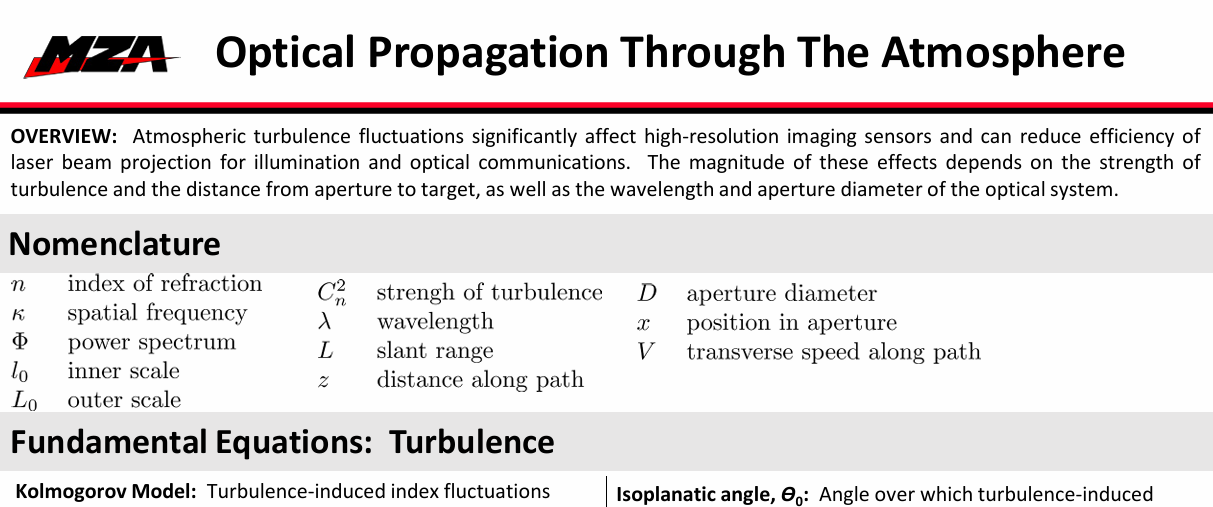
Optical Propagation Through The Atmosphere

Optical Propagation Through The Atmosphere

This document covers how atmospheric turbulence, scattering, and absorption degrade optical systems (like lasers and imaging), and provides the core formulas to measure and correct those distortions.

View Full Details
Atmospheric Distortions: Covers how turbulence, air molecules, and particles cause light loss and wave degradation. Core Metrics: Defines key parameters like Fried's parameter (r0), isoplanatic angle (θ0), Rytov number, and Greenwood/Tyler frequencies. Spectral Models: Outlines Kolmogorov and Modified von Kármán power density spectrum models. Attenuation: Explains total light loss (γ) using combined molecular/aerosol absorption (α) and scattering (σ).

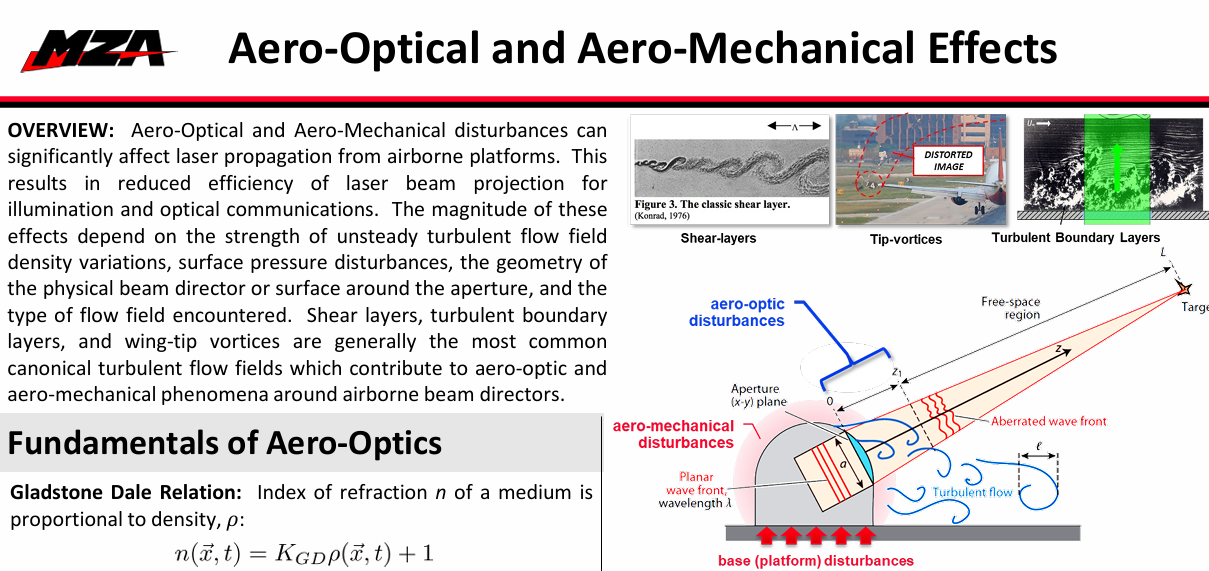
Aero-Optical and Aero-Mechanical Effects

Aero-Optical and Aero-Mechanical Effects

Covers how aerodynamic flow fields (aero-optics) and mechanical vibrations (aero-mechanics) degrade airborne laser projection.

View Full Details
Aero-Optics: Explains Gladstone-Dale relation, OPD, and Maréchal approximation (SR ≈ exp[-(2π·OPD_RMS / λ)²]), showing how flow field density variations and turbulence degrade wavefronts (scaling as ρ·M²·D_t). Aero-Mechanics: Examines structural vibration and mechanical jitter caused by dynamic pressure (q), detailing its impact on peak irradiance and beam alignment.
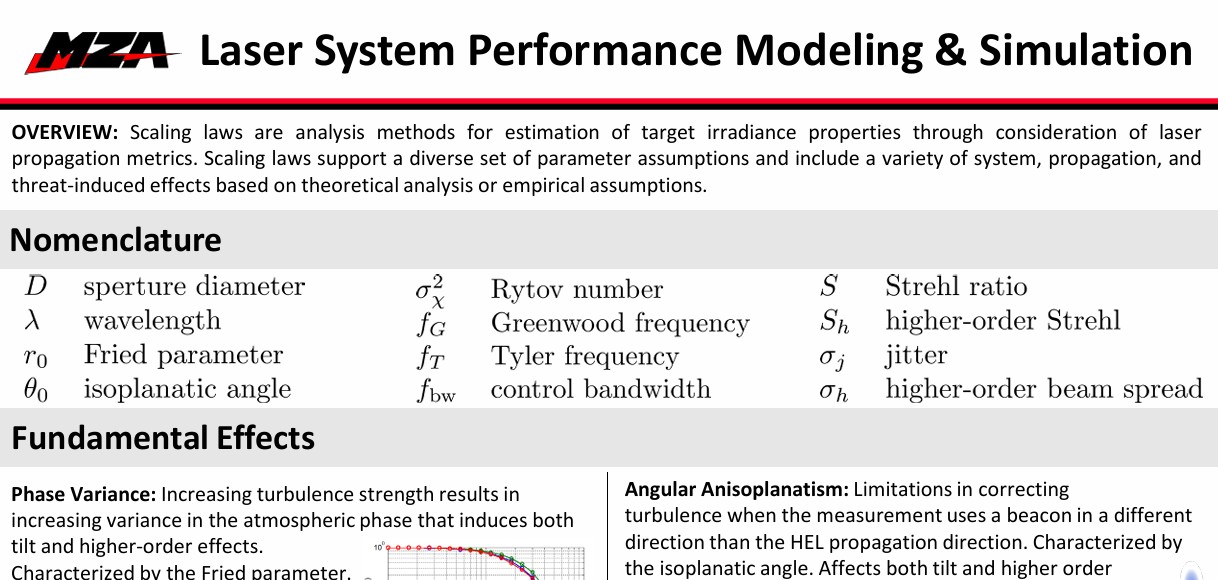
Laser System Performance Modeling & Simulation

Laser System Performance Modeling & Simulation

Examines fundamental physical phenomena and environmental factors that limit directed energy laser system performance.

View Full Details
Fundamental Effects: Details atmospheric phase variance, temporal response limits, anisoplanatism (angular & focal), thermal blooming, scintillation, chromatic dispersion, sensor noise, and extended beacon effects.

In the News & External Media

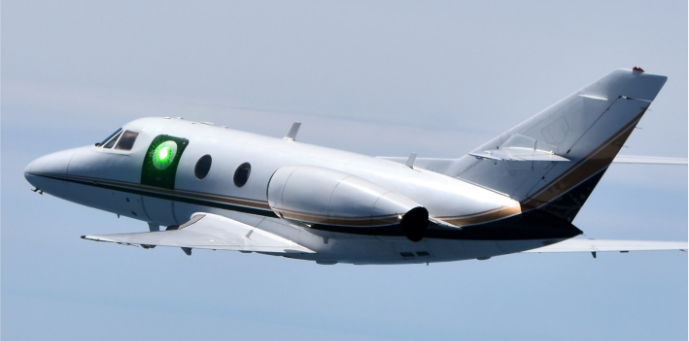
AFRL completes flight tests for directed energy laser system beam director
Air Force Research Laboratory

AFRL completes flight tests for directed energy laser system beam director

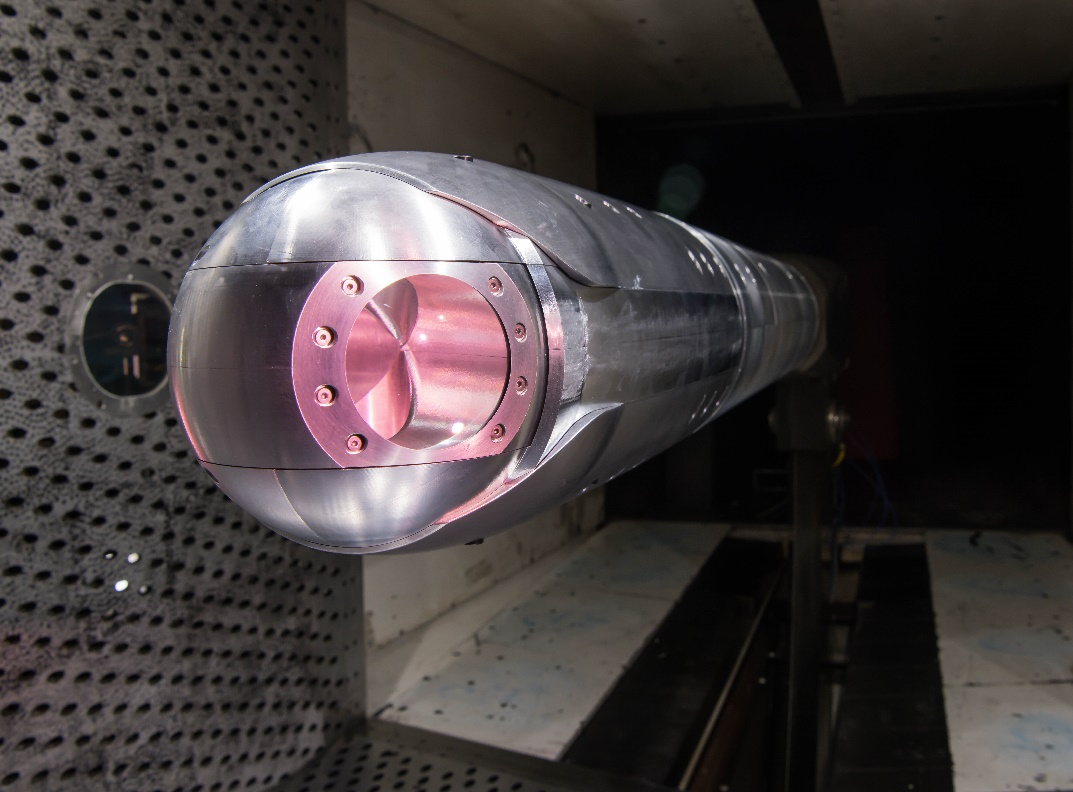
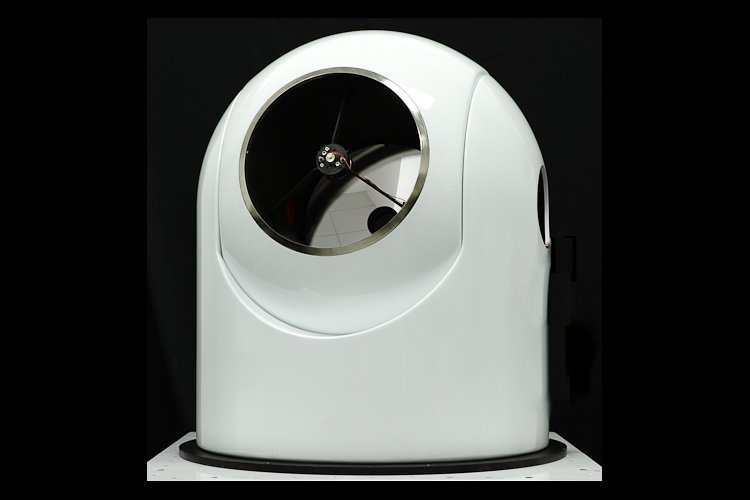
The Air Force Research Laboratory completed flight testing of the Hybrid Aero-Effect Reducing Design with Realistic Optical Components (HARDROC) beam director developed in partnership with MZA Associates.

AFTC gains new test capability
Arnold Engineering Development Complex

AFTC gains new test capability

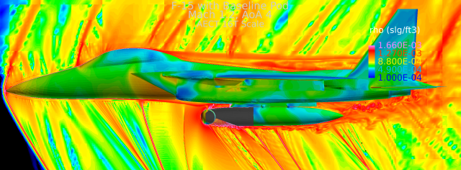
AEDC contracted with MZA Associates Corporation through the SBIR and CRP programs to develop a system that can accurately obtain wavefront information anywhere around aircraft models in transonic and supersonic wind tunnels.

US Navy Awards $18.7M Development Contract to MZA Associates
Unmanned Airspace

US Navy Awards $18.7M Development Contract to MZA Associates

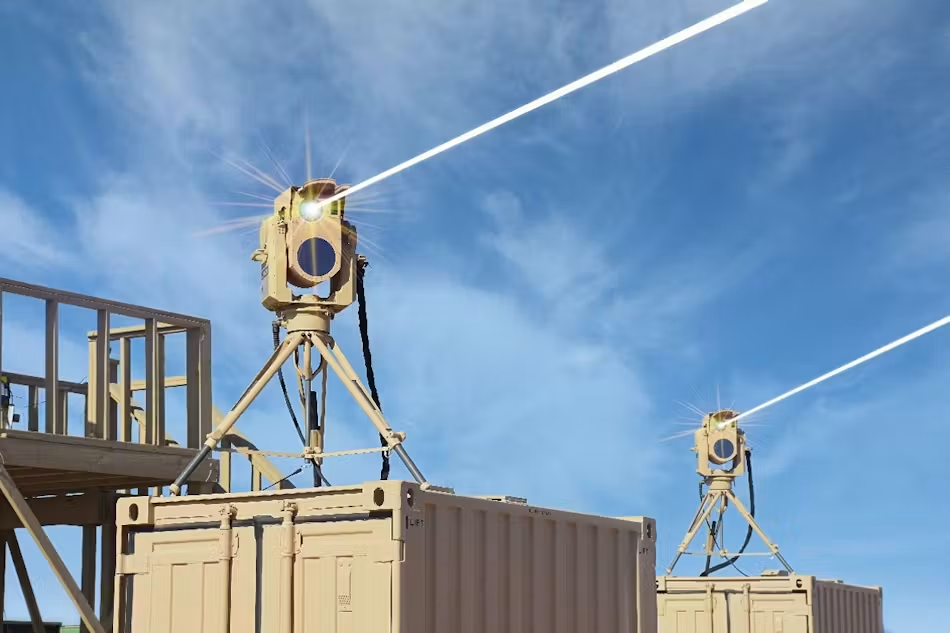
Media coverage detailing the Office of Naval Research contract awarded to MZA for compact counter-UAS laser weapon development.

Navy Taps MZA Associates to Develop Portable Laser Weapons
Military Aerospace

Navy Taps MZA Associates to Develop Portable Laser Weapons

An in-depth report on MZA's contract to design, integrate, and demonstrate a low-cost, compact C-UAS High Energy Laser Weapon System.

AEDC tests directed energy system in wind tunnel
Arnold Engineering Development Complex

AEDC tests directed energy system in wind tunnel

The Air Force Research Laboratory completed flight testing of the Airborne High Energy Laser (AHEL) beam director developed in partnership with MZA Associates.

MZA Associates Awarded C-UAS HELWS Contract
Joint Forces

MZA Associates Awarded C-UAS HELWS Contract

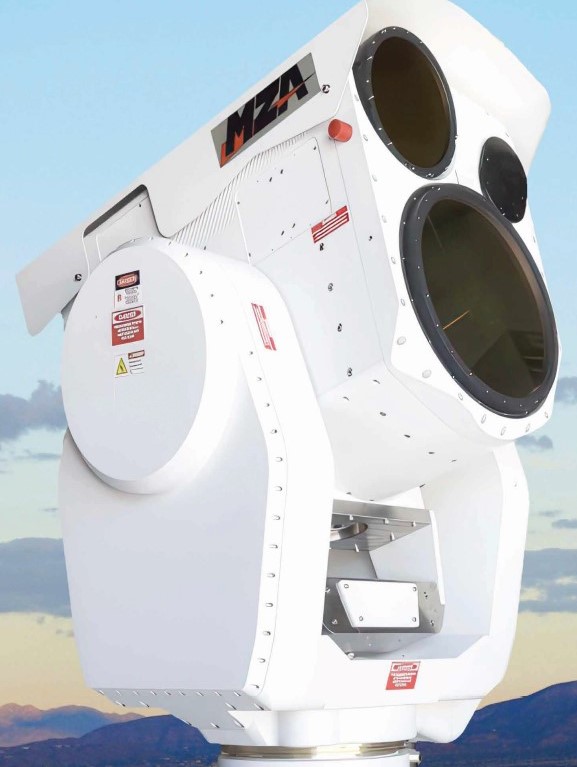
Defense equipment report highlighting the US Department of Defense contract notice featuring the MZA Othela beam director.

Technical Papers & Publications

Highly accurate centroid tracking for real-time event-based Shack–Hartmann wavefront sensing
Applied Optics

Highly accurate centroid tracking for real-time event-based Shack–Hartmann wavefront sensing

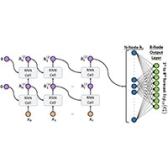
A recurrent neural network approach for processing event camera data streams to improve slope estimation accuracy and wavefront reconstruction in adaptive optics.

A modularized architecture for localized UAV detection and tracking using convolutional neural networks and state-space models
SPIE Pattern Recognition and Prediction XXXVII

A modularized architecture for localized UAV detection and tracking using convolutional neural networks and state-space models

Proposes a modularized pipeline combining convolutional neural network feature extraction with state-space models for localized UAV detection and trajectory tracking.

Machine Learning and Event-Based Camera for Microlens Array-Based Optical Systems
University of Dayton

Machine Learning and Event-Based Camera for Microlens Array-Based Optical Systems

Ph.D. dissertation detailing event-based algorithm development, neural network architectures for Shack-Hartmann wavefront sensing, and coded aperture system feasibility.

A Modular Algorithmic Architecture for Small UAV Detection and Tracking
IEEE Xplore

A Modular Algorithmic Architecture for Small UAV Detection and Tracking

This paper presents a three-part modular algorithm that uses advanced computer vision techniques to detect and track unauthorized drones.

Improved Centroid Tracking for Event-Based Shack-Hartmann Wavefront Sensing
Optica Imaging Congress 2025

Improved Centroid Tracking for Event-Based Shack-Hartmann Wavefront Sensing

Demonstrates a low-complexity recurrent neural network applied to event streams for sub-half-pixel spot displacement tracking in Shack-Hartmann wavefront sensors.

Turbulence Forecasting With Machine Learning Optimized for Numerical Weather Prediction Data
Optica Imaging Congress 2025

Turbulence Forecasting With Machine Learning Optimized for Numerical Weather Prediction Data

Explores machine learning pipelines adapted for numerical weather prediction data to forecast spatial and temporal atmospheric turbulence behavior.

Atmospheric characterization and profiling with ProfilerTools
SPIE Unconventional Imaging, Sensing, and Adaptive Optics

Atmospheric characterization and profiling with ProfilerTools

Describes ProfilerTools, a MATLAB-based software suite developed by MZA Associates for testing and evaluating wavefront sensor data and performing atmospheric profiling.

Phenomenology of weather-driven diurnal and nocturnal optical turbulence trends
SPIE Optical Engineering + Applications

Phenomenology of weather-driven diurnal and nocturnal optical turbulence trends

Investigates atmospheric turbulence trends and environmental drivers across diurnal and nocturnal cycles for enhanced system modeling.

Eclipse Turbulence Evaluation and Sensor Testing (eTEST)
Optica Sensing Congress 2024

Eclipse Turbulence Evaluation and Sensor Testing (eTEST)

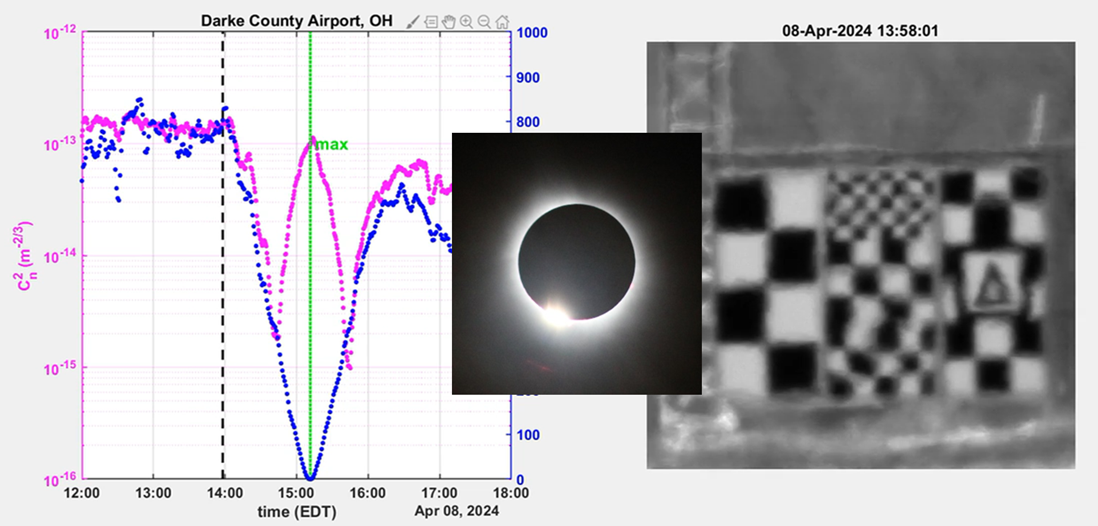
Analyzes optical turbulence and correlated weather measurements collected along the path of totality during the April 8, 2024 total solar eclipse.

Subpixel object tracking in RGB intensity and depth imagery
SPIE Pattern Recognition and Tracking XXXV

Subpixel object tracking in RGB intensity and depth imagery

Presents subpixel accuracy tracking methods applied across multi-modal RGB intensity and depth sensor feeds for improved target localization.

Convolutional neural network for improved event-based Shack-Hartmann wavefront reconstruction
Applied Optics

Convolutional neural network for improved event-based Shack-Hartmann wavefront reconstruction

Real-time event-based CNN providing sub-pixel spot-tracking accuracy for Shack-Hartmann wavefront sensors at 800+ Hz.

Modified Huygens-Fresnel method for the propagation of partially coherent beams through turbulence
Journal of the Optical Society of America A

Modified Huygens-Fresnel method for the propagation of partially coherent beams through turbulence

Analytical method for evaluating partially coherent beams in turbulence by reformulating beam moment calculations into free-space propagation models.

Forecasting atmospheric turbulence conditions from prior environmental parameters using artificial neural networks
Applied Optics

Forecasting atmospheric turbulence conditions from prior environmental parameters using artificial neural networks

presents a deep learning framework using recurrent neural networks to forecast near-term daytime atmospheric optical turbulence from prior meteorological measurements.

Optical image processing of 2-D and 3-D objects using digital holography
SPIE Practical Holography XXXVII: Displays, Materials, and Applications

Optical image processing of 2-D and 3-D objects using digital holography

Explores spatial filtering techniques in off-axis digital holography to perform optical edge enhancement on 2-D and 3-D reconstructed objects.

Semi-analytic simulation of optical wave propagation through turbulence
Applied Optics

Semi-analytic simulation of optical wave propagation through turbulence

Semi-analytic split-step simulation method for two-screen atmospheric turbulence, offering relaxed sampling constraints, flexible computational grids, and faster multi-frame processing.

3D multi-plane sharpness metric maximization with variable corrective phase screens
Applied Optics

3D multi-plane sharpness metric maximization with variable corrective phase screens

Multi-plane sharpness metric maximization enables 3D digital holography image reconstruction through distributed-volume turbulence.

Optical Kerr effect field measurements and ad hoc engineering model comparisons
Optics Express

Optical Kerr effect field measurements and ad hoc engineering model comparisons

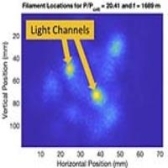
Analytical model for predicting atmospheric laser filamentation onset and channel radius, validated against simulation data and 1.5-micron field experiments.

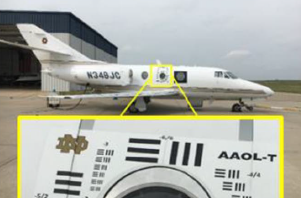
Aircraft to Ground Profiling: Turbulence Measurements and Optical System Performance Modeling
AIAA Journal

Aircraft to Ground Profiling: Turbulence Measurements and Optical System Performance Modeling

A series of flight experiments have demonstrated a novel approach to measuring path-resolved optical turbulence strength along an 8 km air-to-ground slant path.